This official companion site accompanies the Thinking in the Age of Answers
books and gathers the Better Judgement visuals in one place for readers, discussion
groups, and new visitors discovering the work for the first time.
Book 1 explains the disciplines behind the visuals and why human judgement matters
when answers are increasingly easy to produce. Book 2 carries those same concerns
into practical moves, gates, checks, and pauses in real work. Book 3 is now also
available and extends the wider series.
You may have arrived here from a QR code inside the book, or you may have found the
site independently. Either way, this page is designed to help you explore the cards
and understand the books they come from.
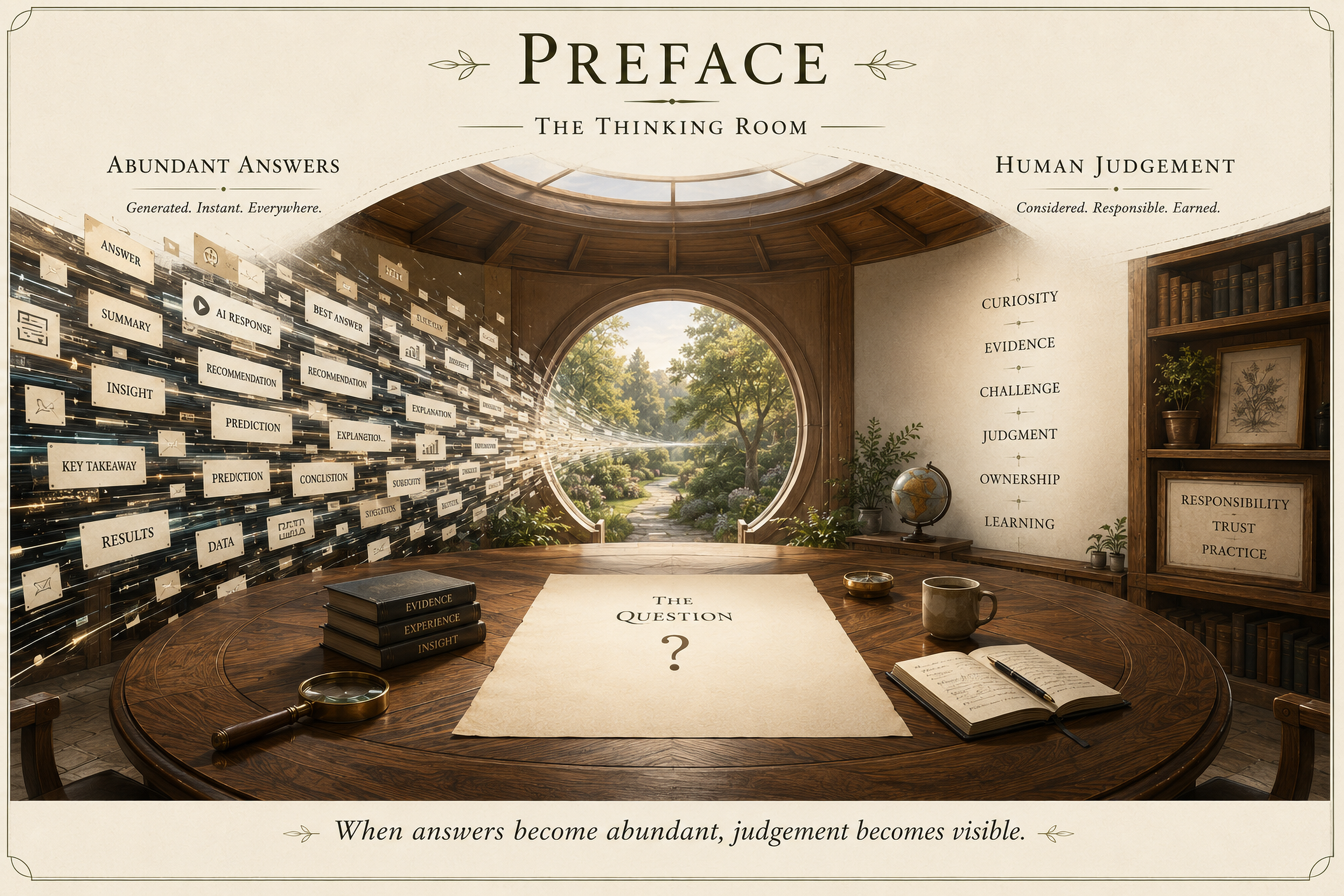
The Preface image introduces the world the books are responding to: abundant
answers, persistent uncertainty, and the need for human judgement.
Preface
What this site is for
A visual route into the books, not just an image archive
Why judgement matters here
When answers are abundant, speed is easy and judgement is harder. These visuals
are designed to slow thinking down just enough to ask better questions, examine
evidence, test conclusions, and learn from what happens next.
The books explain the ideas in full. This site gives you a visual route into them:
you can explore the cards first, then read the books for the deeper argument and
chapter-level context behind each discipline.
Eight disciplines. One ecology. Better judgement.
Three books, different roles
Book 1 explains the ecology. Book 2 carries it into practice. Book 3 extends the wider series.
Book 1
The ecology of better judgement
Book 1 introduces the disciplines themselves: question, curiosity, evidence,
challenge, judgement, ownership, learning, and reflection.
Its concern is philosophical and formative. It helps a reader understand what
better judgement is, why it matters, and what strengthens it.
“I have read book 1 of the trilogy, so far. It is insightful and opens up a whole new dynamic as to the concept of judgment in the age of AI. What we all consider to be such a natural and instinctive feature of our day to day living is opened up and examined in a skilful and fascinating way. Well worth a read.”
Recommendation fromMartyn Booth
How to use the cards
Three useful ways in
Read
Use a card as a way back into a chapter, idea, or visual theme from the books.
Discuss
Put one card in the middle of a conversation and let it frame what matters most.
Practise
Bring a card to a live decision and use it as a question, pause, or check.
Worked example
Imagine a team receives an AI-generated summary of an academic article and needs to
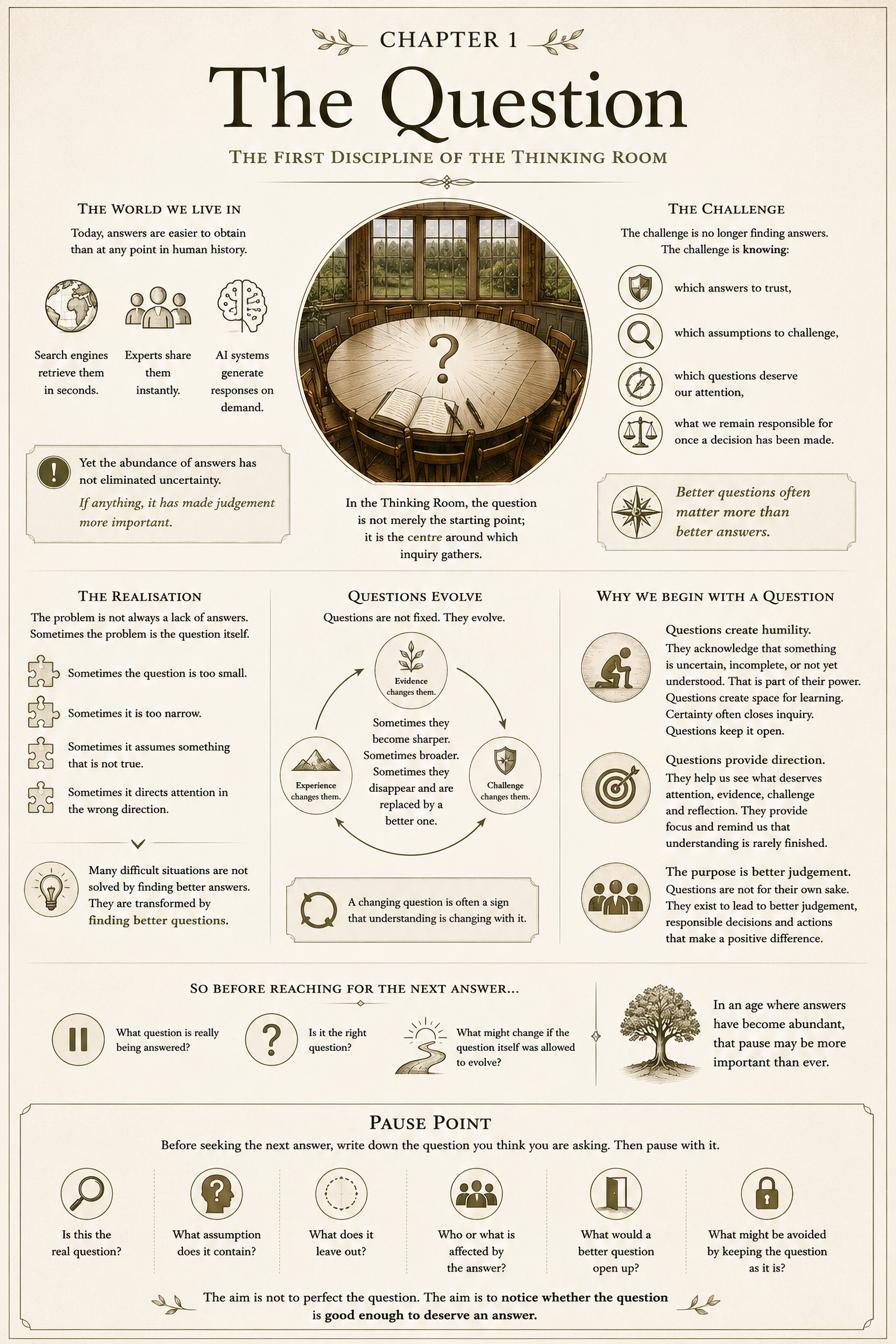
decide whether to rely on it. The Question card asks what decision
is actually being made. The Evidence card asks what is grounded in
the source rather than the summary. The Challenge card asks what
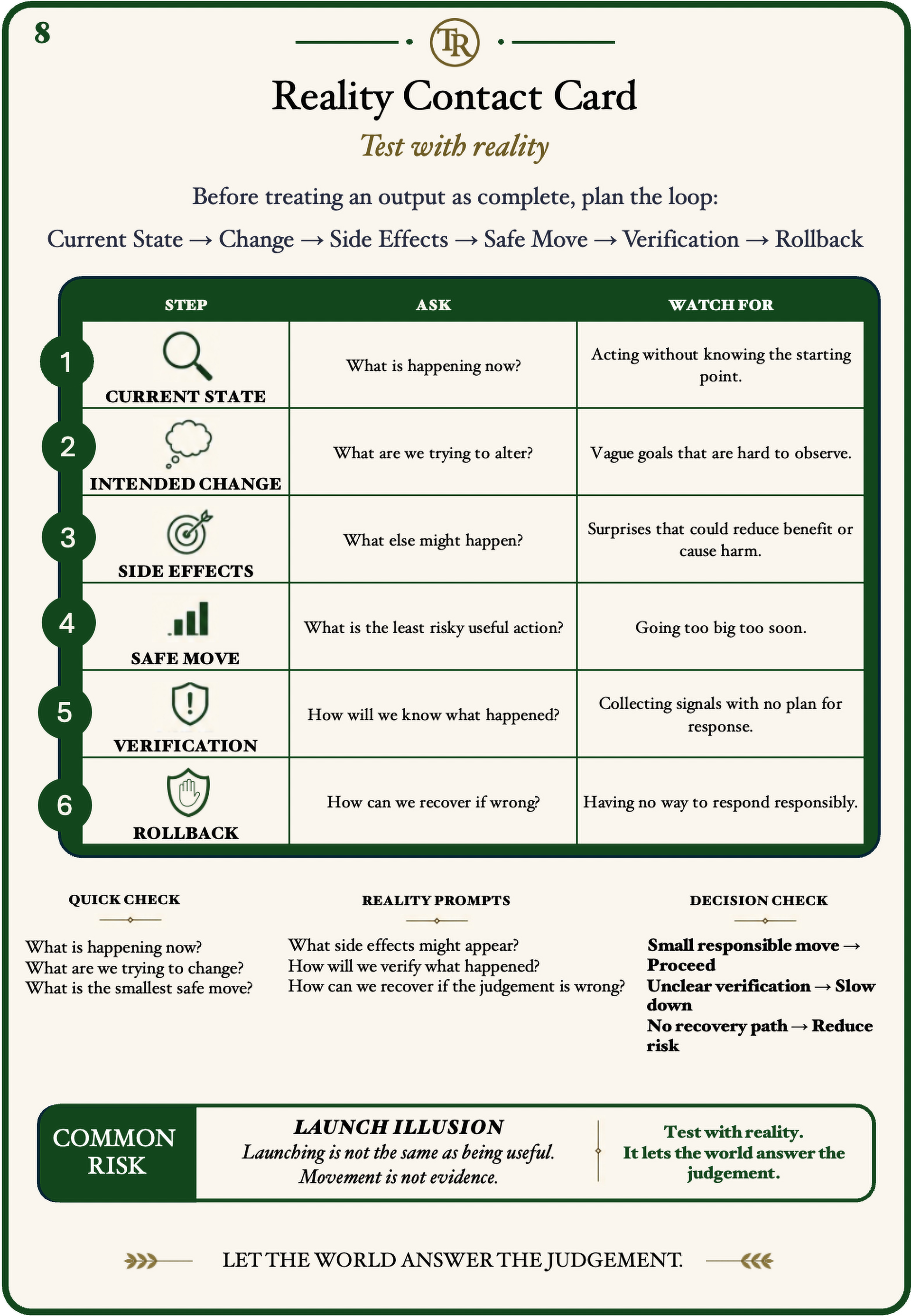
could be wrong, missing, or overconfident. The Book 2 companion cards
then turn those same moves into practical checks before action.
Primary sequence
From philosophy to practice
Each step below pairs a Book 1 discipline with its Book 2 counterpart where the
title genuinely aligns. The Book 2 pairings are companion materials from the
second book. The final step is presented as a transition rather
than a forced equivalence.
01
The move that sets direction
Question
Better judgement begins by asking what question is actually being answered.
This protects against rushing toward a neat answer before the problem itself
has been properly named.
Try asking: What decision is really in front of us?
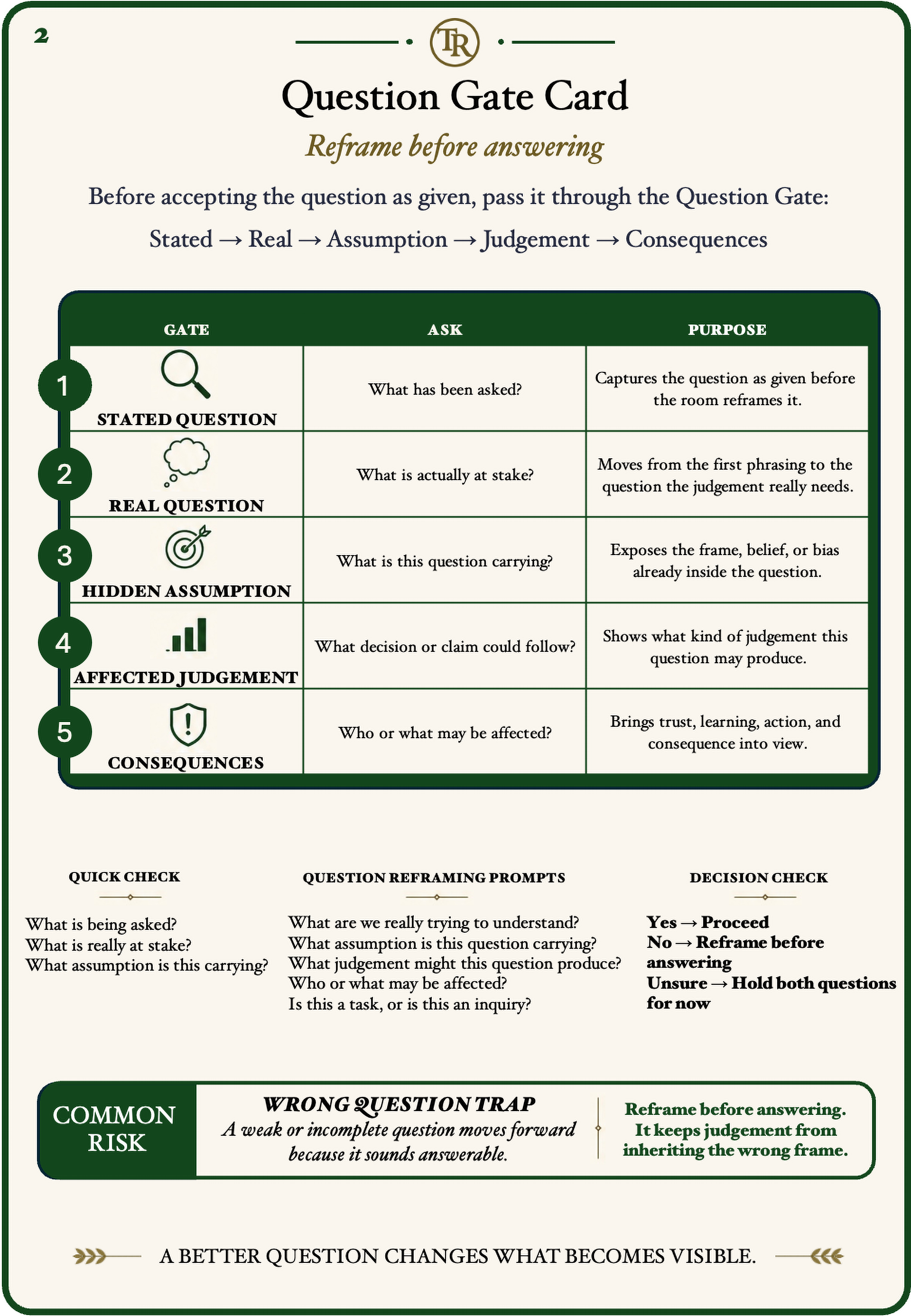
Book 2 adds: a practical question gate that keeps the work
from moving forward on a vague or borrowed premise.
Book 1 philosophyBook 2 practice
02
Keeping inquiry alive
Curiosity
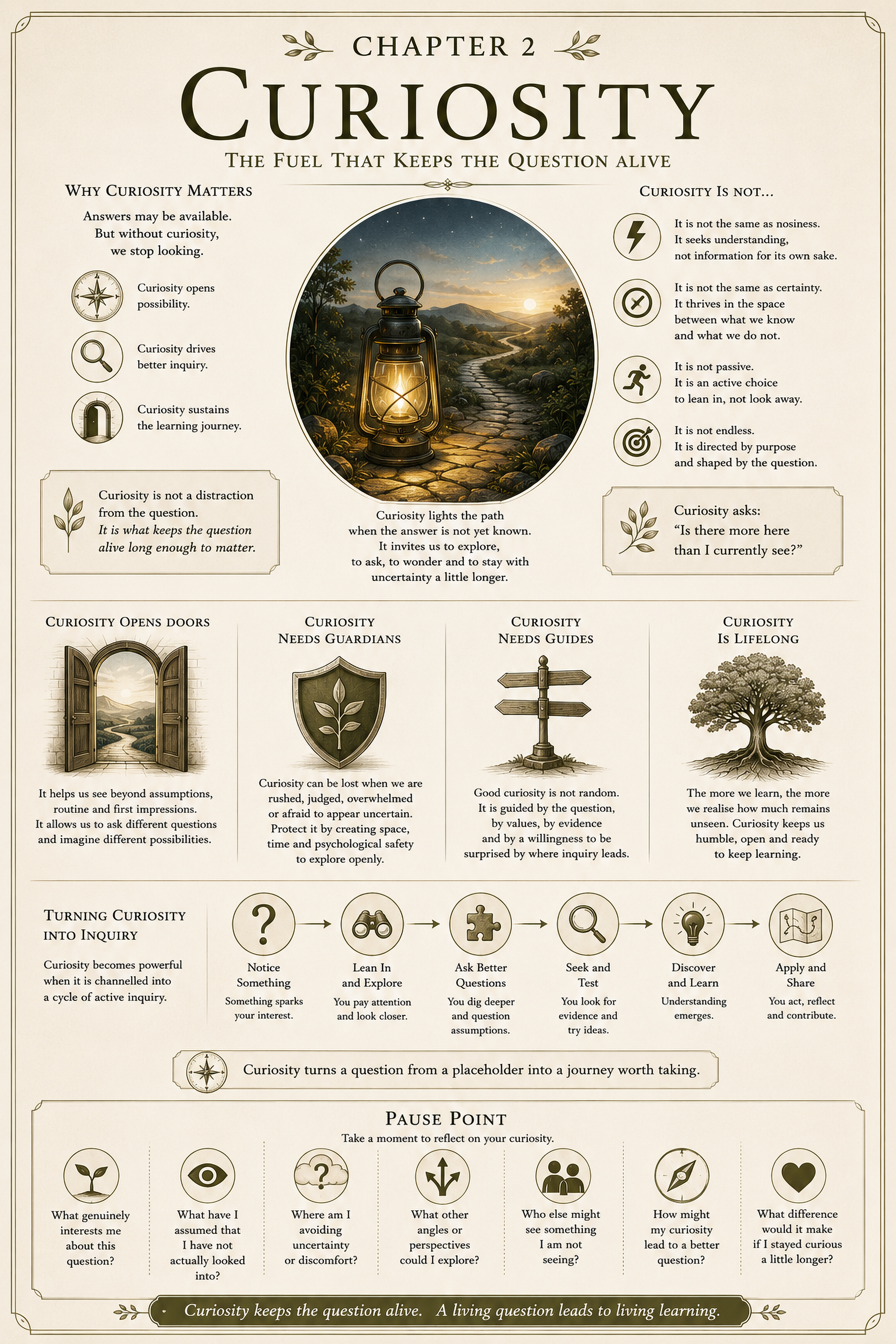
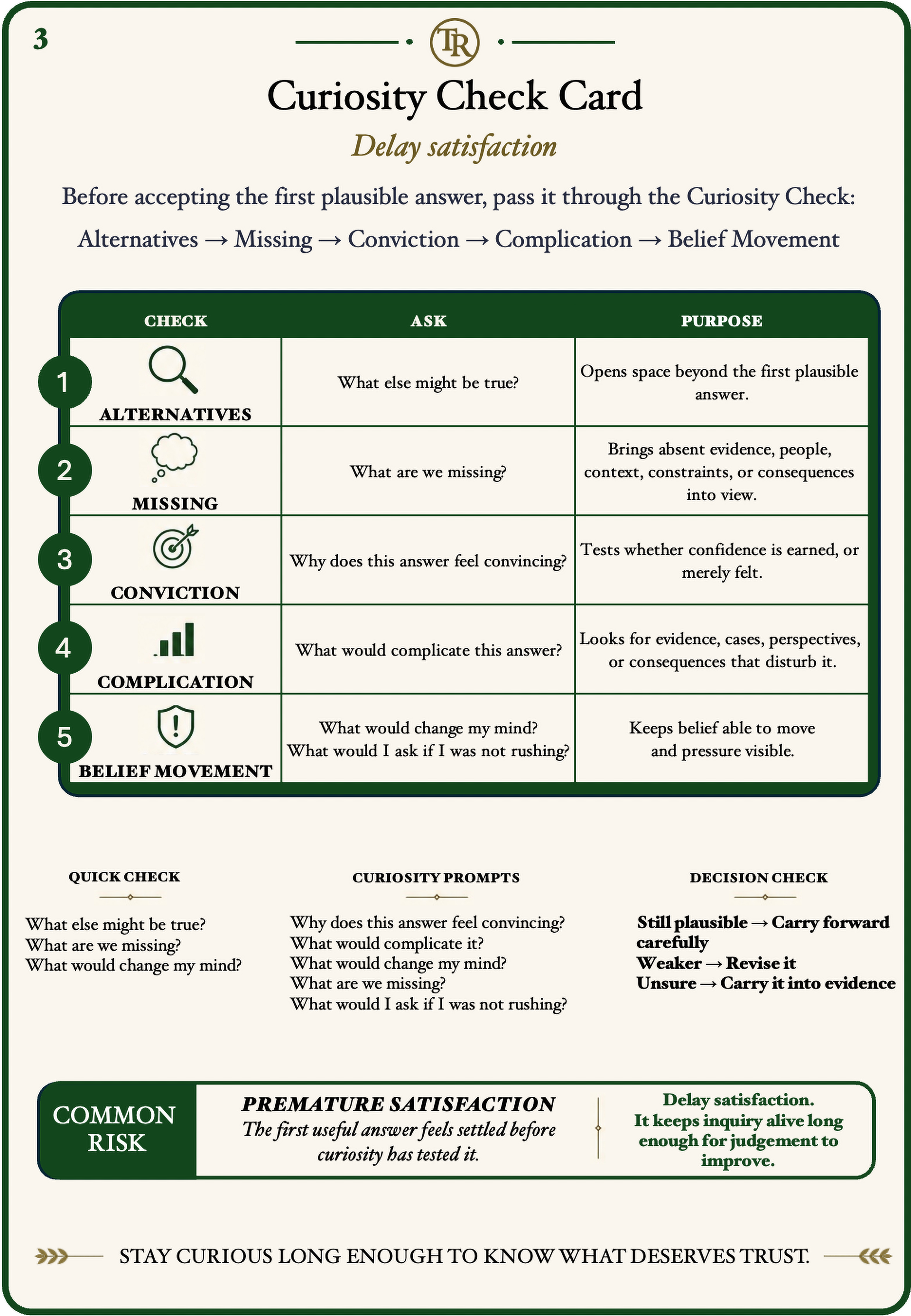
Curiosity resists premature closure. It protects against the desire to settle
too quickly for the first plausible answer, especially when that answer arrives
fluently.
Try asking: What have we stopped noticing too early?
Book 2 adds: a practical curiosity check that keeps the
inquiry open long enough for better judgement to form.
Book 1 philosophyBook 2 practice
03
Grounding the claim
Evidence
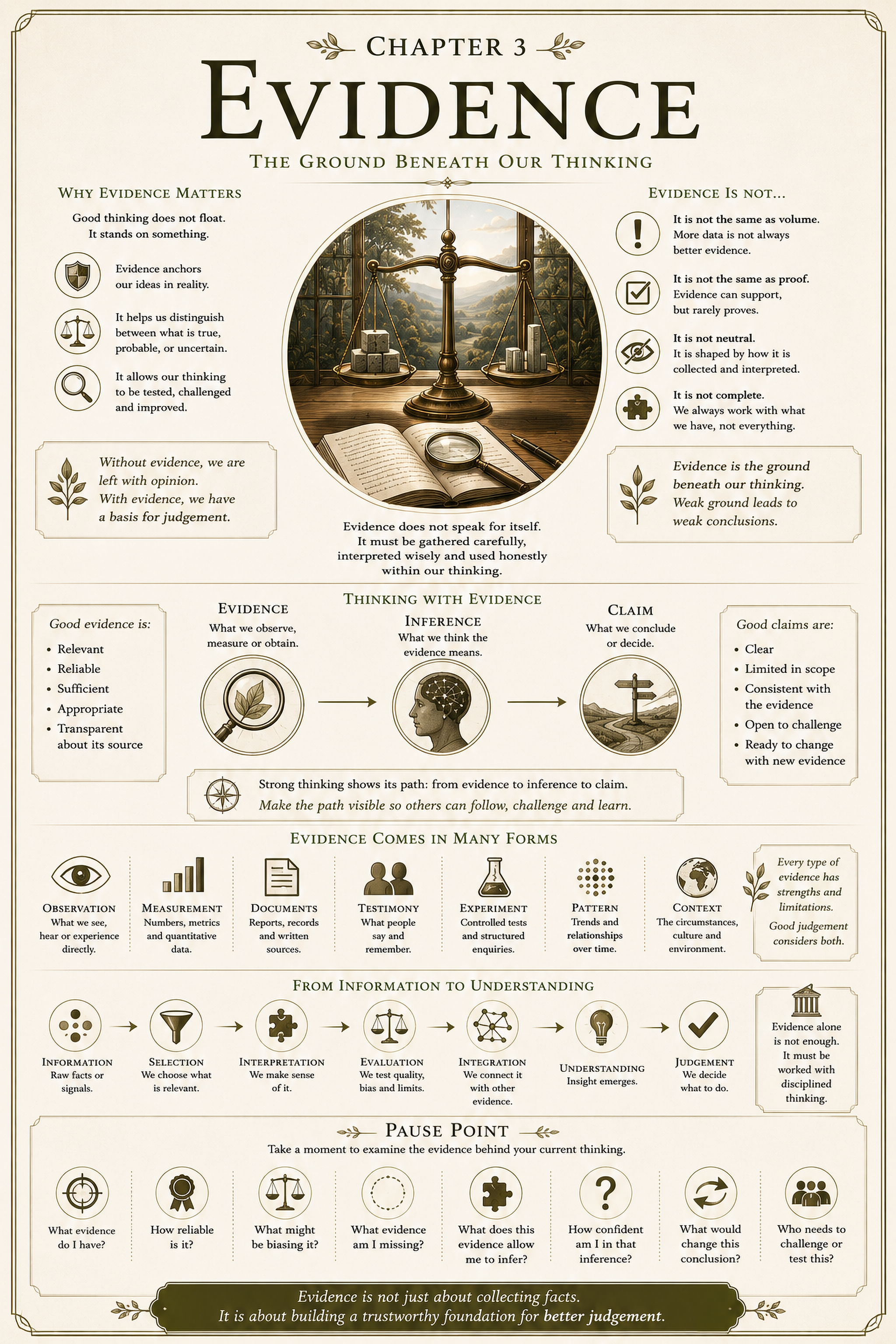
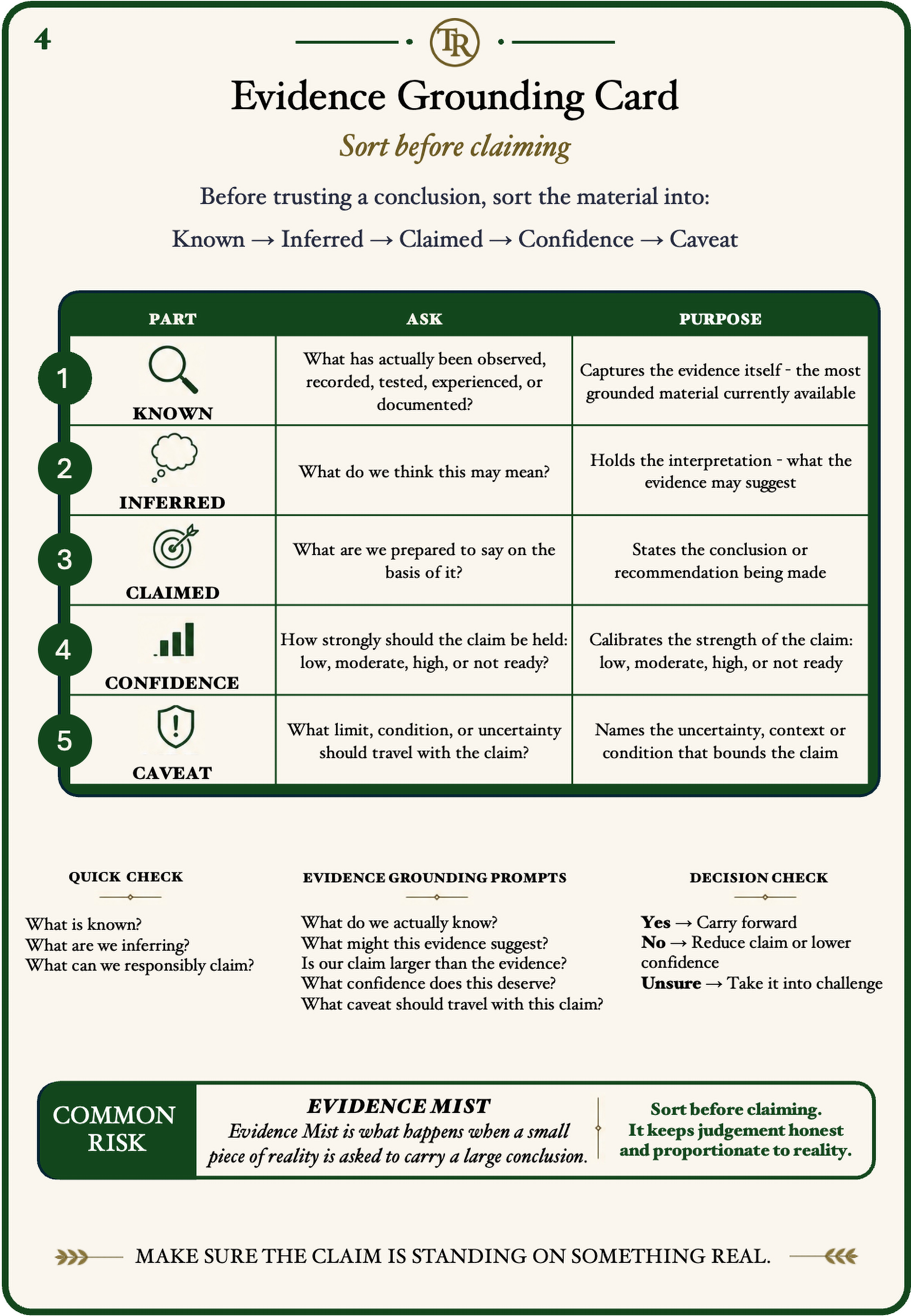
Evidence asks what is actually so. It protects against thinking that sounds
complete but has drifted away from the source, the record, or the reality it
claims to describe.
Try asking: What is grounded here, and what is only inferred?
Book 2 adds: a more operational evidence check suited to live
judgements, where time pressure can tempt people to skip verification.
Book 1 philosophyBook 2 practice
04
Testing what we want to believe
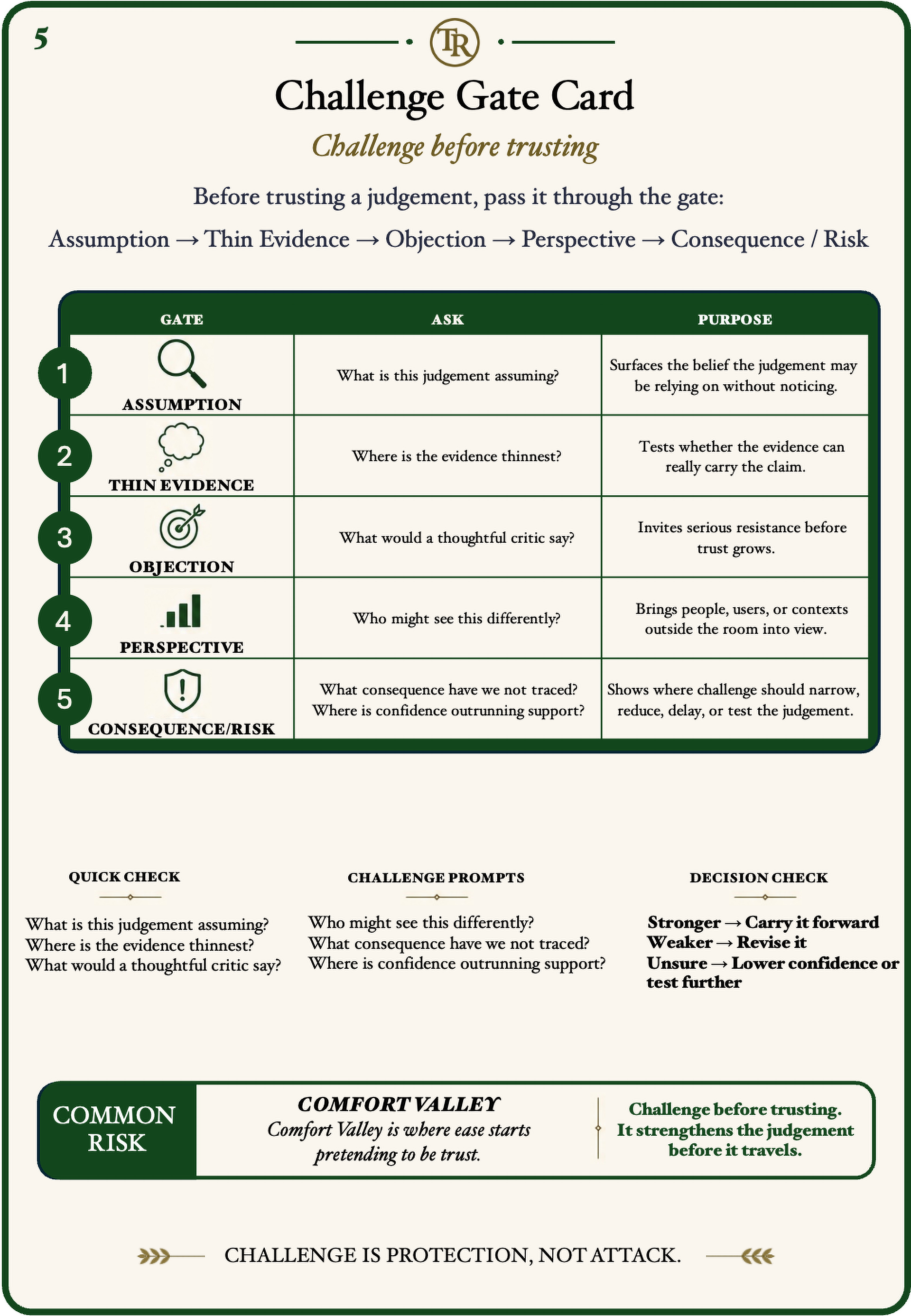
Challenge
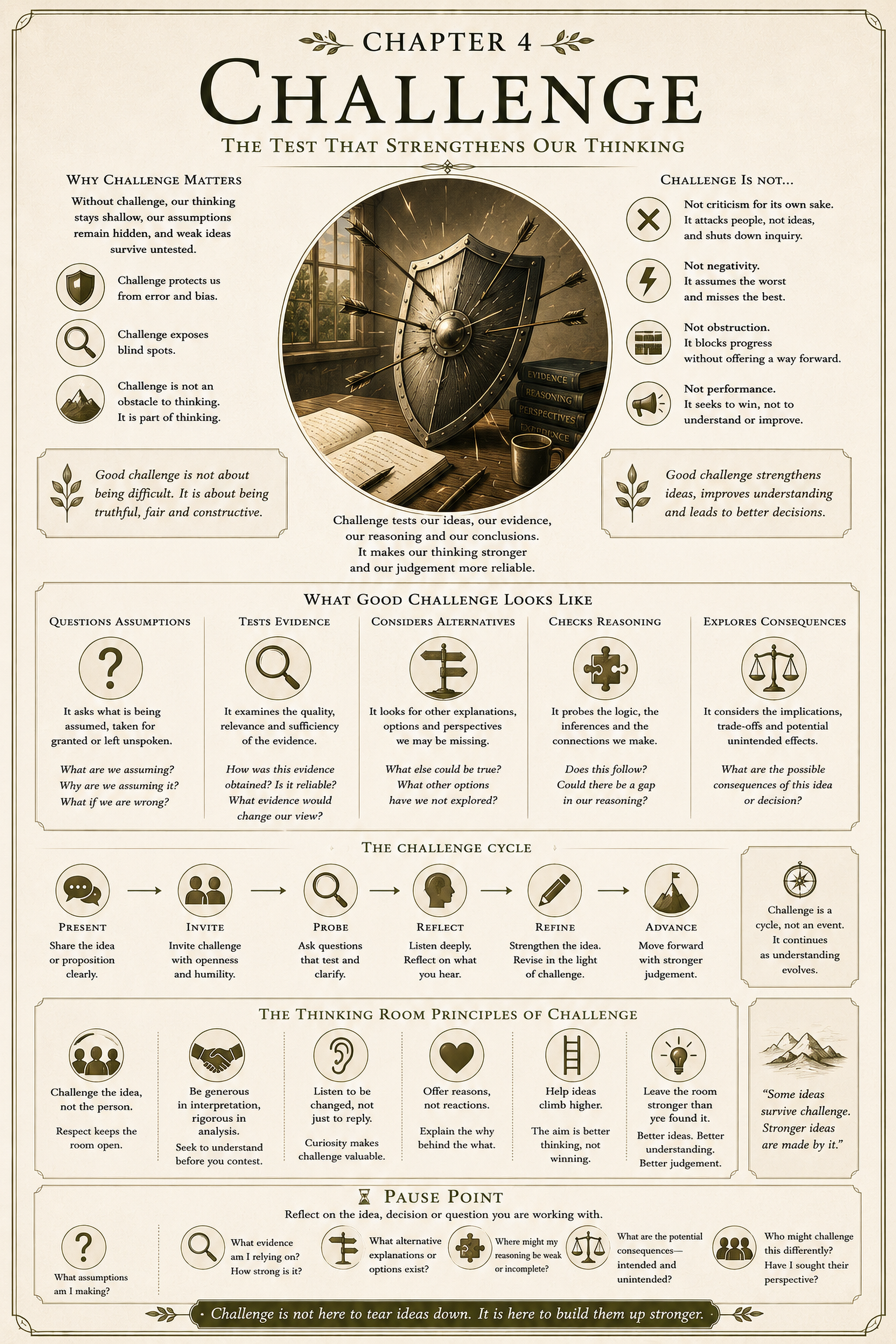
Challenge strengthens judgement by exposing it to resistance. It protects
against self-confirmation, overconfidence, and the comfort of untested claims.
Try asking: What would a serious objection sound like?
Book 2 adds: a challenge gate that invites pressure-testing
before a judgement hardens into action.
Book 1 philosophyBook 2 practice
05
Forming a responsible conclusion
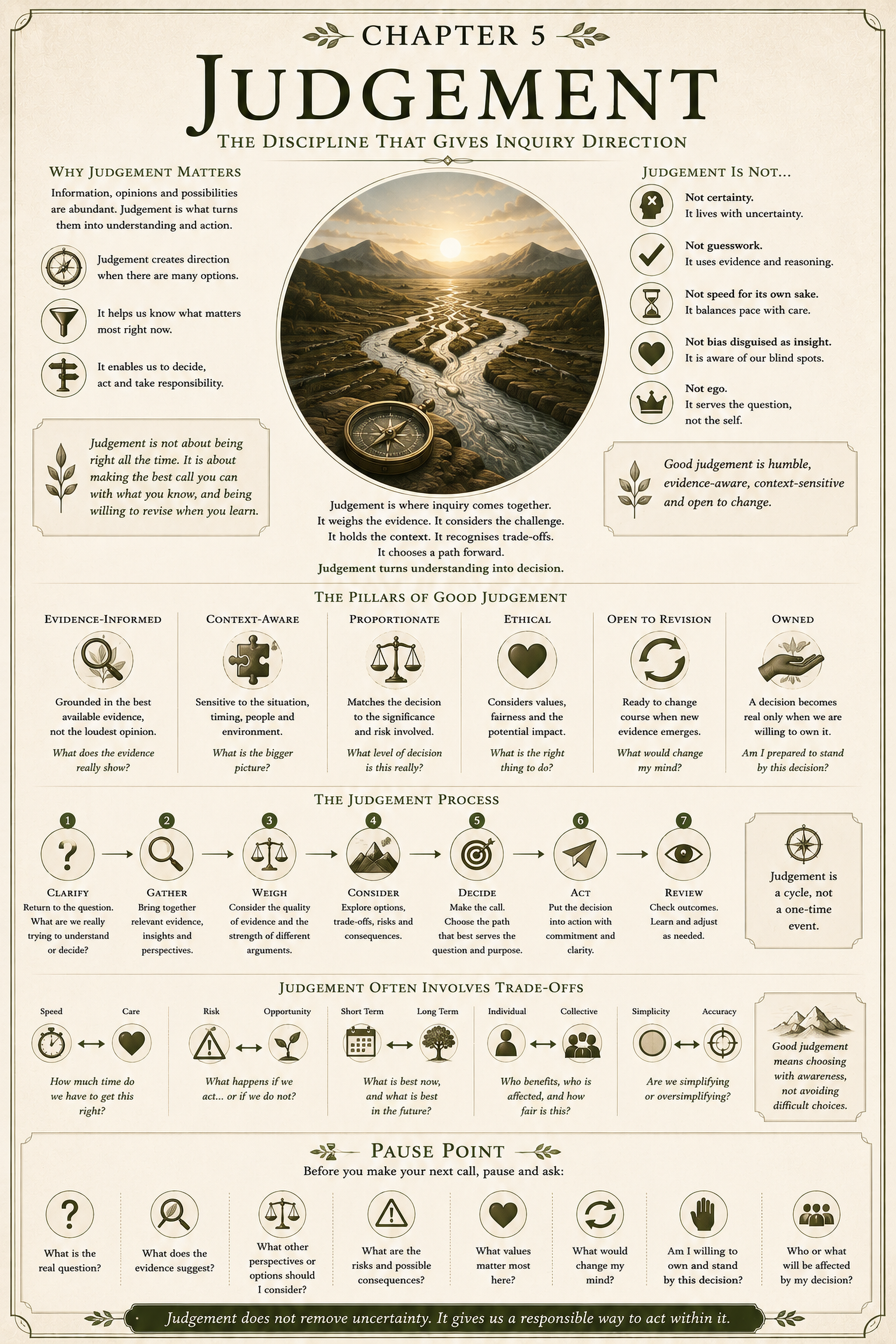
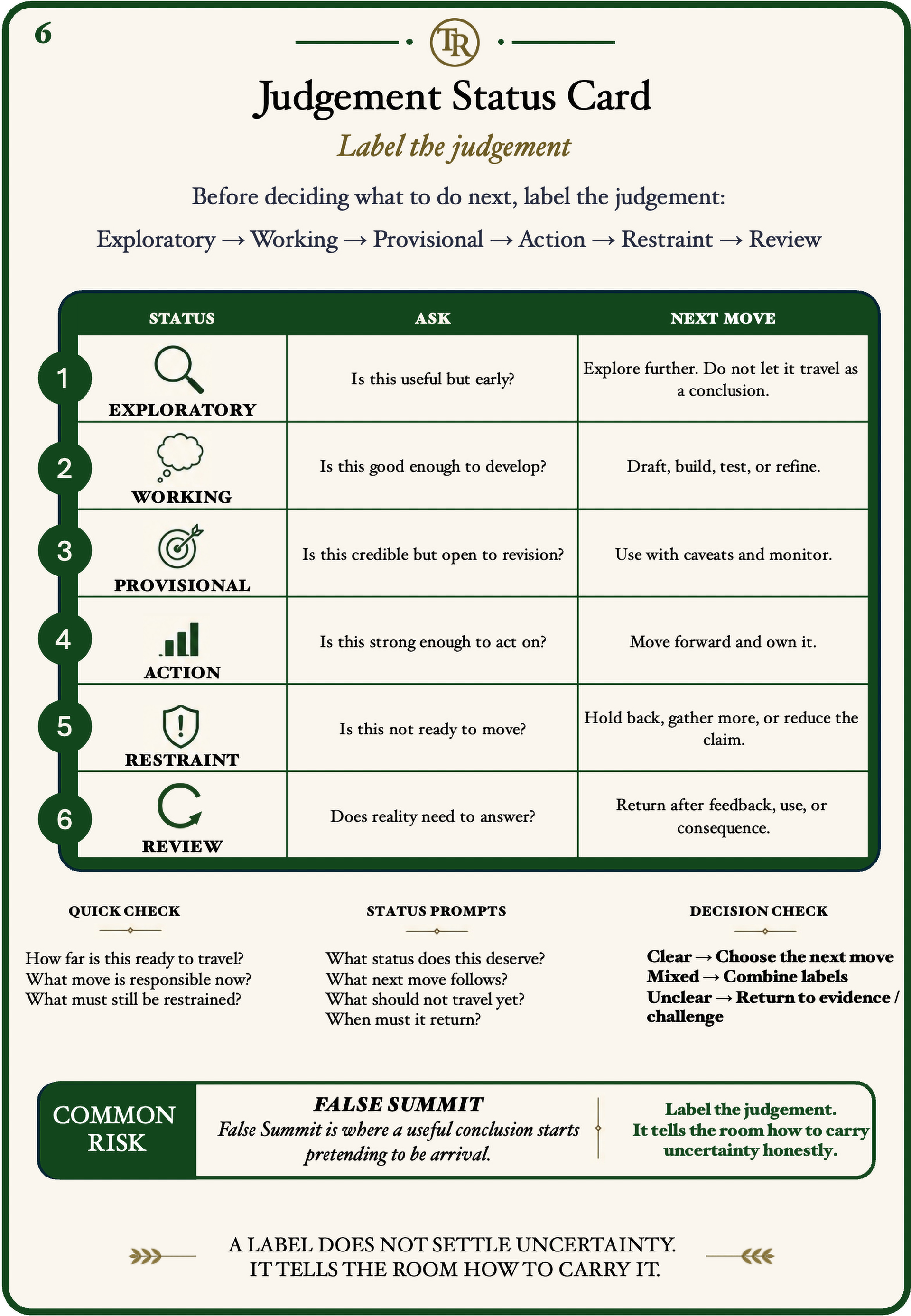
Judgement
Judgement is not certainty. It is the best responsible conclusion available
under real conditions of uncertainty, evidence, and consequence.
Try asking: What conclusion can we stand behind, and why?
Book 2 adds: a judgement-status card that helps people locate
whether a live decision is ready, premature, or still underformed.
Book 1 philosophyBook 2 practice
06
Staying close to consequence
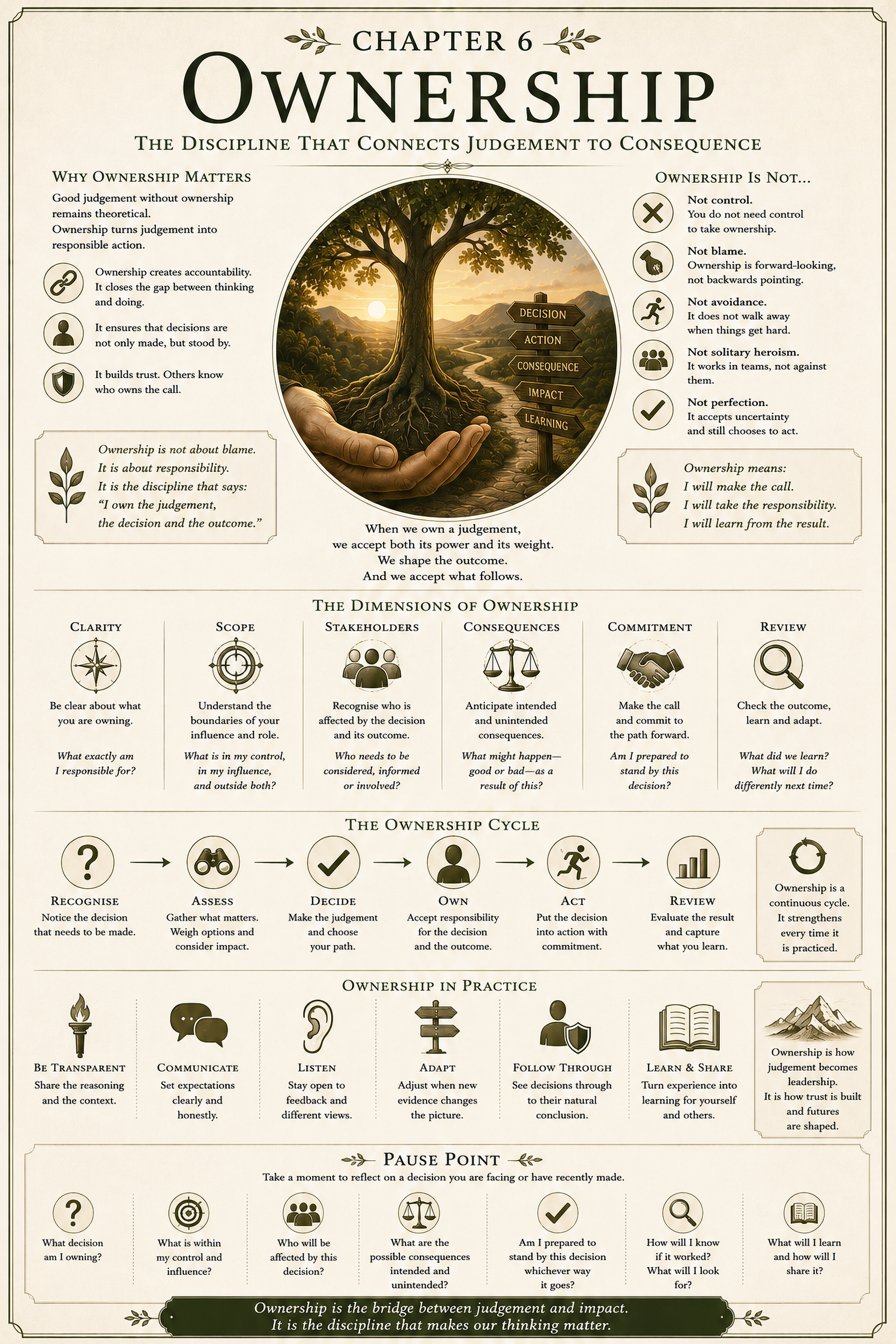
Ownership
Ownership keeps judgement connected to responsibility. It protects against the
temptation to make bold claims while staying far away from the consequences.
Try asking: Who stands behind this judgement when it lands?
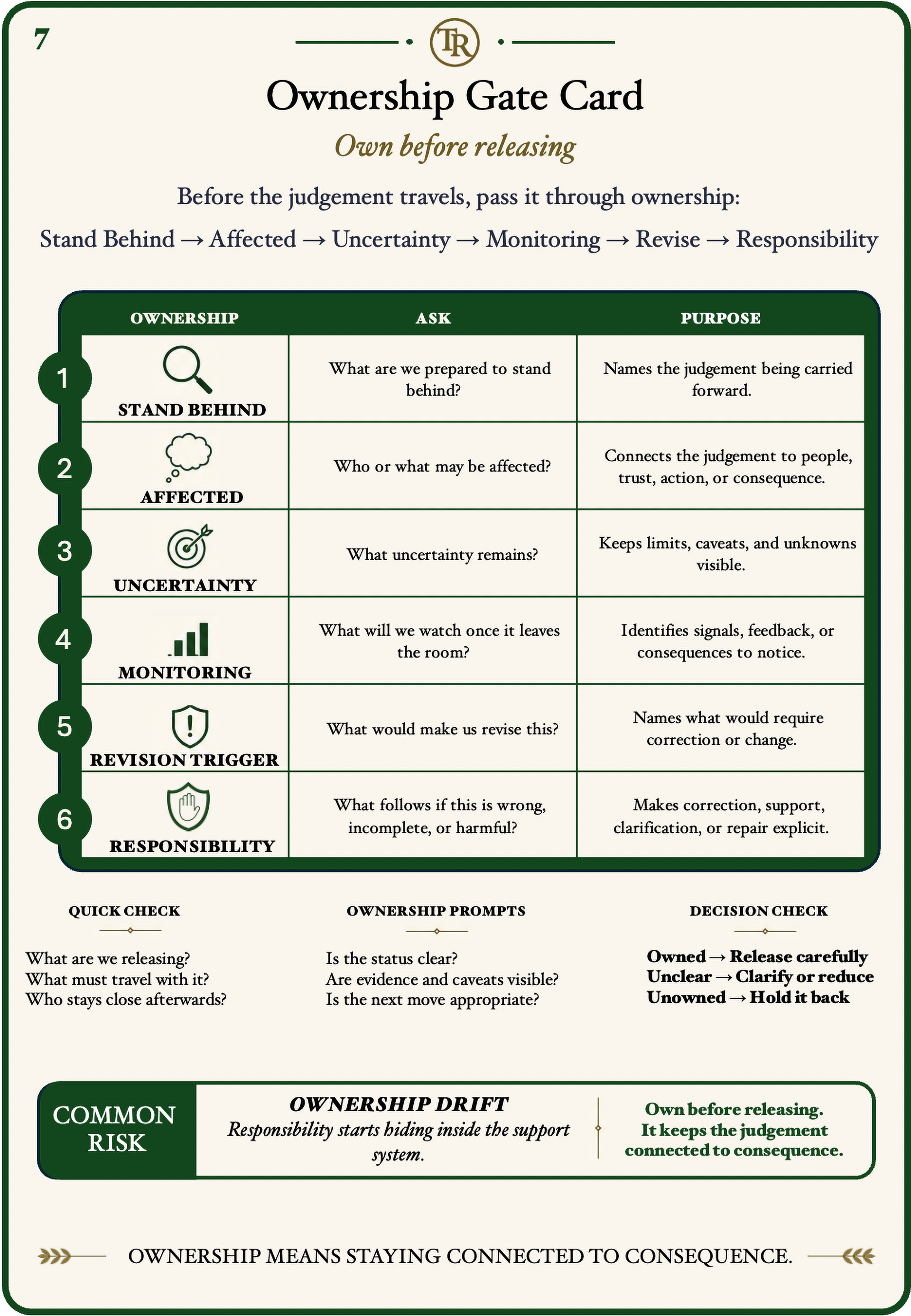
Book 2 adds: a working ownership gate that asks whether the
decision remains close enough to the people, stakes, and effects involved.
Book 1 philosophyBook 2 practice
07
Turning experience into improved judgement
Learning
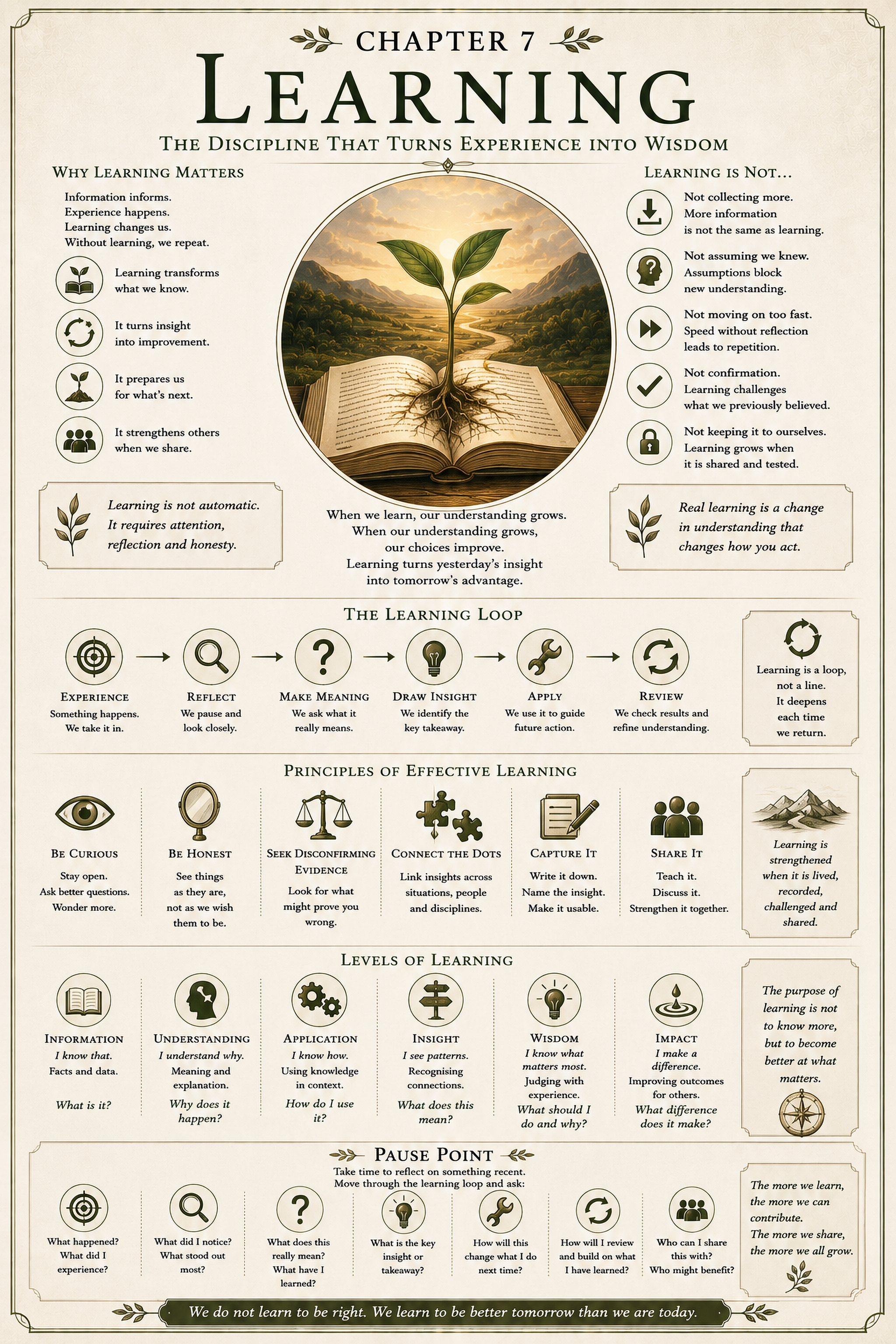
Learning closes the loop. It protects against repeating a process that felt
persuasive in the moment but did not improve judgement over time.
Try asking: What changed in our understanding after action?
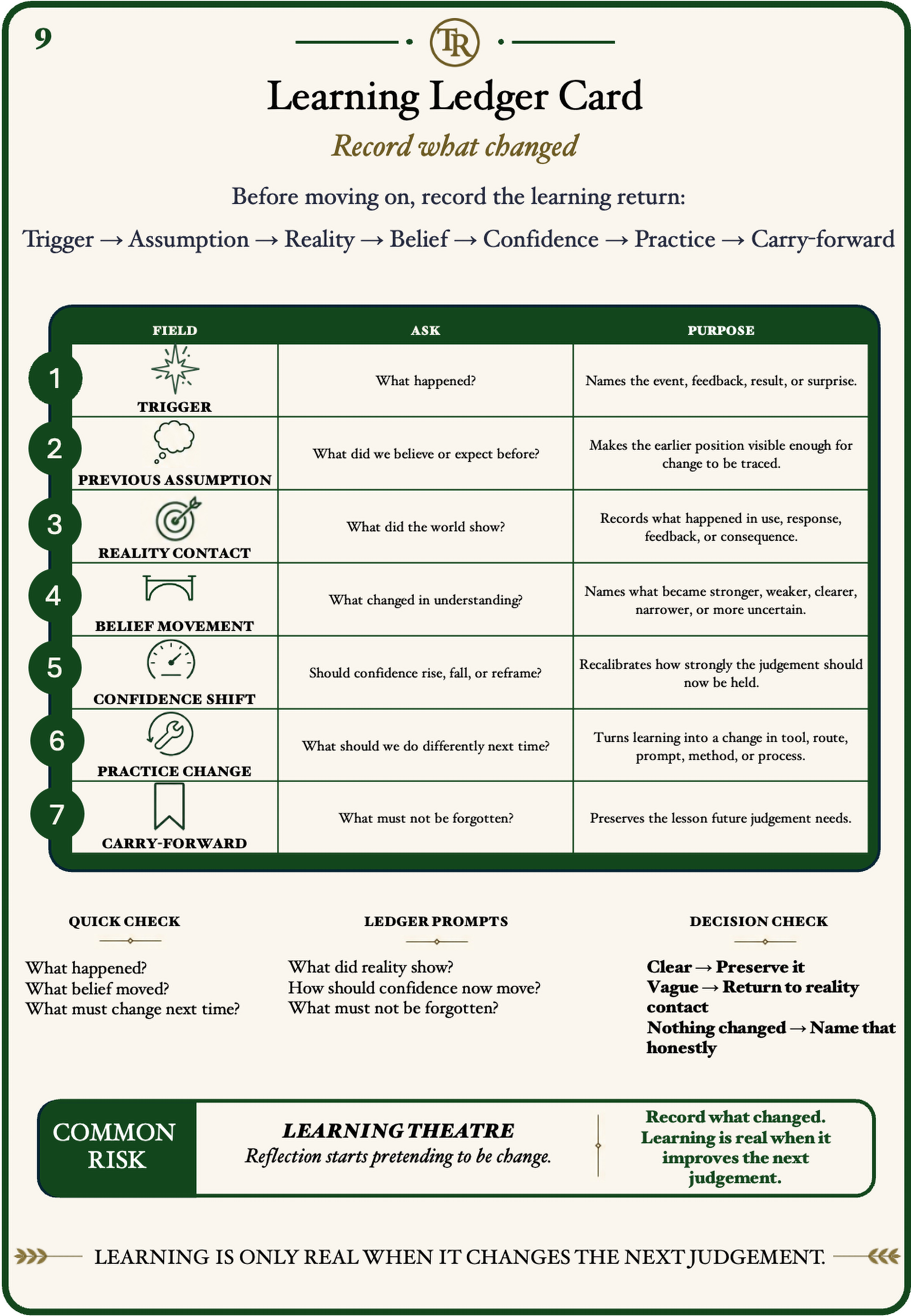
Book 2 adds: a learning ledger that makes reflection more
deliberate, traceable, and reusable.
Book 1 philosophyBook 2 practice
08
A transition, not a forced title match
Reflection to Reality Contact
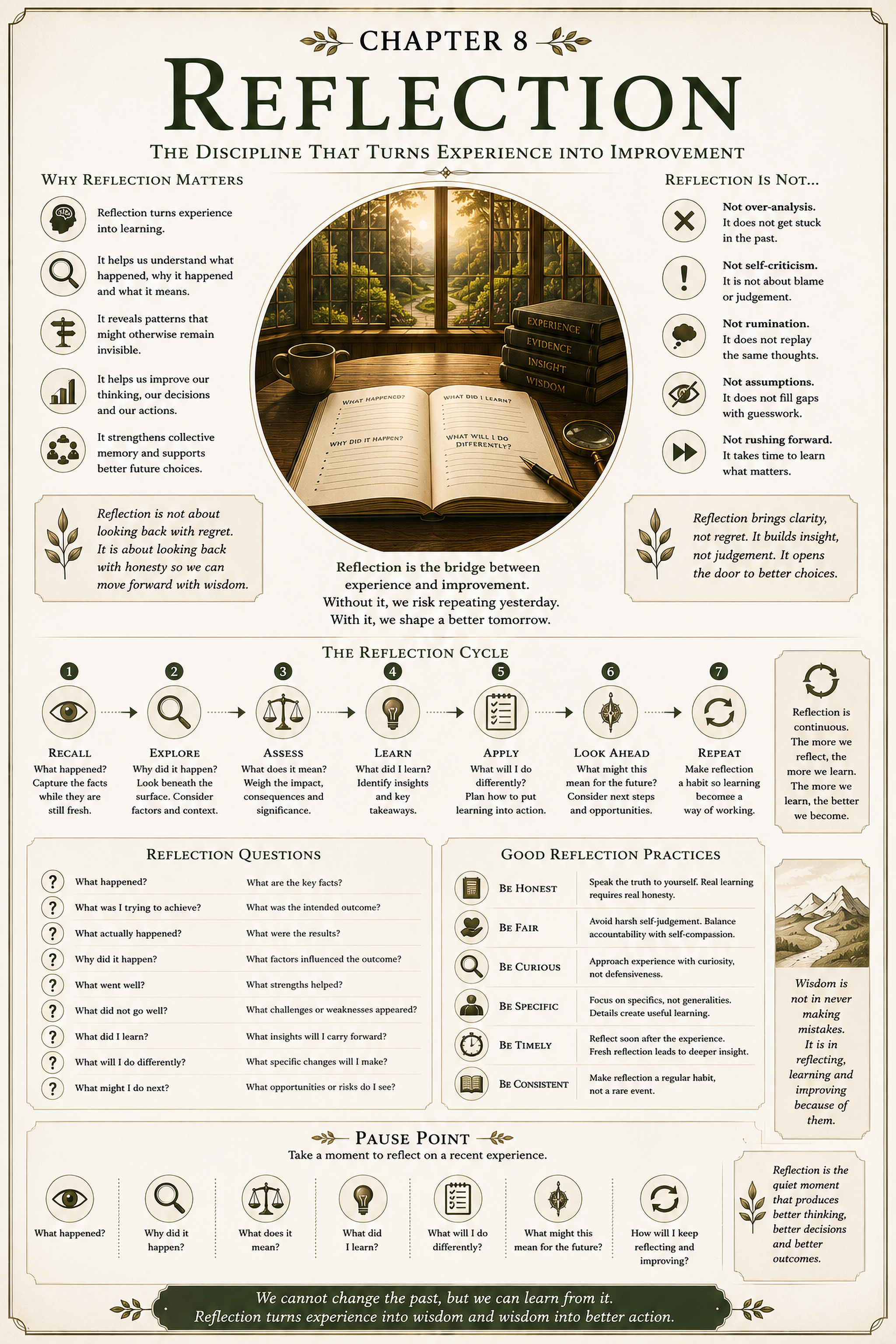
Book 1 closes with reflection: looking back on judgement and what it has
become. Book 2 extends that movement into reality contact: what actually
happened once the judgement met the world.
That makes them related, but not identical. Reflection returns inward with
understanding. Reality contact returns outward with consequence.
Book 1 reflectionBook 2 reality contact
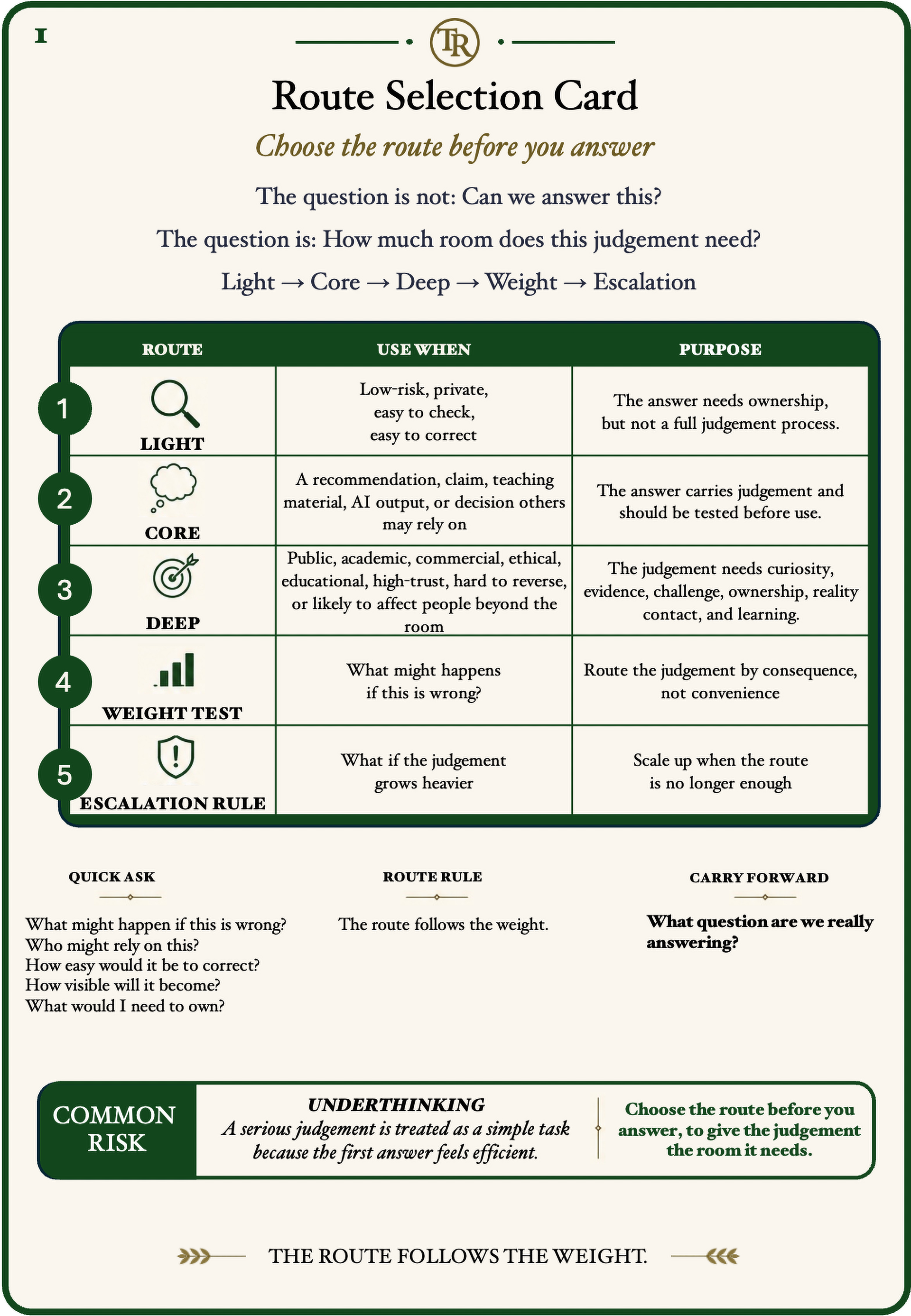
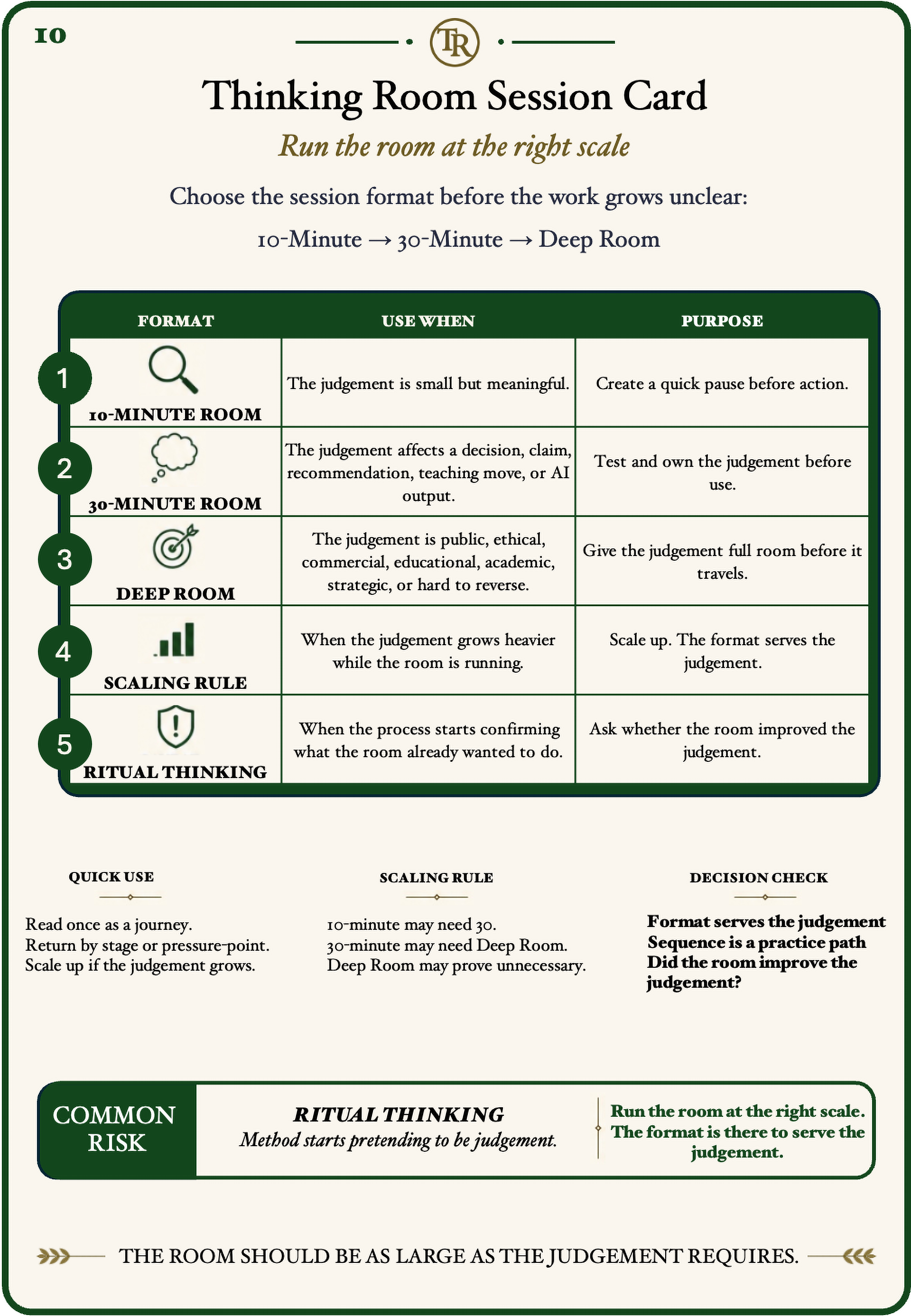
Book 2 extensions
Practical cards that expand the core sequence
These cards do not have direct Book 1 title twins, but they show what the practical
book adds: entry routes, contact with reality, and the problem of
scale.
Route
The route card helps people choose how to enter the work before any conclusion is made.
Reality contact
Reality contact asks what happened when the judgement met actual conditions rather than intention.
Scale
Scale tests whether a good local judgement still holds when the work grows in reach or consequence.
Visual library
Chapter plates across the books
The primary path through this site is the paired-card sequence. These additional
chapter visuals sit together here as deeper browsing and reference across Books 1, 2,
and 3.
Open Book 1 chapter visuals
Chapter 1
Chapter 2
Chapter 3
Chapter 4
Chapter 5
Chapter 6
Chapter 7
Chapter 8
Open Book 2 chapter visuals
Chapter 1
Chapter 2
Chapter 3
Chapter 4
Chapter 5
Chapter 6
Chapter 7
Chapter 8
Chapter 9
Chapter 10
Open Book 3 chapter visuals
The Thinking Room Public Philosophy Map
The Thinking Room Public Overview
The Room Before the Room
The Conversation Starts Remembering
A Safe Place to Stand
Constitution Formation
Different Chairs, Same Source
One Body of Work Becoming Three Books
The Centre of Gravity
Reality Contact
The Centre of Gravity Poster
The Fable of the Cartographer
Answer Birds
Answer Birds, The Room
Downloads
Printable companion cards
Better Judgement printable bundle
Download the full printable card bundle containing the Book 1 discipline cards and
the Book 2 companion cards.
This bundle is useful for reading groups, workshops, preparation, or
owner-authorised educational use.
This is a visual companion to Thinking in the Age of Answers. It brings
together the Better Judgement cards, key visuals from the books, and a printable
bundle for readers, groups, and new visitors.
Do the books explain the visuals?
Yes. Book 1 explains the disciplines and ideas behind the visuals in full.
Book 2 extends those ideas into practical use, and Book 3 is now also available
as part of the wider series.
How can I use the cards?
You can use them to revisit ideas from the books, open a discussion, or bring a
practical thinking prompt into a live question or decision.
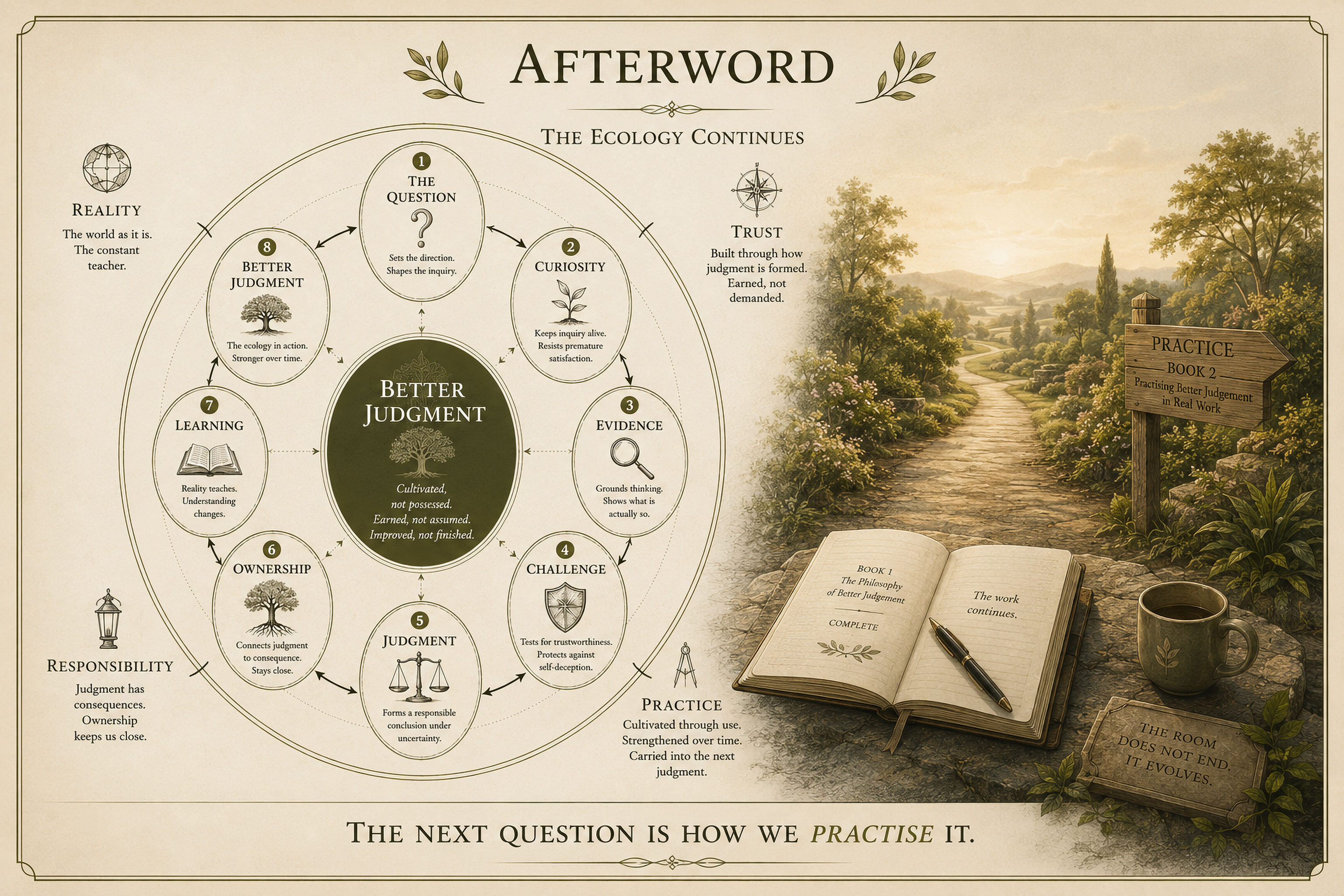
Closing visual
Afterword
The Afterword image closes the sequence by returning judgement to practice,
consequence, and the next question.
Afterword
Recent development
The Thinking Room Companion was recently entered into OpenAI Build Week
The books and visuals now also connect to a live product experiment: a ChatGPT app
designed to turn answers into visible, accountable judgement.
Hackathon entry
The Thinking Room Companion on Devpost
The Devpost entry describes a human-governed judgement system inside ChatGPT where
AI proposes, organises, and challenges, while the human decides what enters the
final record and remains responsible for the judgement.
It explains the problem the app responds to, how the room works, how it was
built, and why explicit human confirmation matters when answers become easy to
produce.
This site introduces the ideas and visual language of the Thinking Room. The
hackathon project shows how those same concerns can become a working product inside
ChatGPT, with a visible room, proposal review, and a human-owned judgement record.
Together, they connect the book series, the card sequence, and the practical
question of how judgement can still be protected in the age of abundant answers.